" height="42.609px" id="Jp5yKR43w" transform="translate(2.363 1.638)" width="42.608999999999995px"/><path d="M 17.497 7.589 C 17.497 7.589 18.998 5.992 18.889 4.095 C 18.779 2.416 17.101 0.465 17.101 0.465 C 17.101 0.465 15.681 2.894 15.777 4.245 C 15.996 6.415 17.524 7.589 17.483 7.589 Z M 22.492 3.453 C 23.175 2.17 22.806 0 22.806 0 C 22.806 0 20.663 1.147 20.172 2.17 C 19.353 3.876 19.954 5.419 19.954 5.419 C 19.954 5.419 21.742 4.914 22.478 3.453 Z M 14.863 6.019 C 14.863 6.019 15.368 4.095 14.44 2.634 C 13.62 1.351 11.45 0.533 11.45 0.533 C 11.45 0.533 11.383 3.098 12.051 4.095 C 13.157 5.773 14.863 6.019 14.863 6.019 Z M 9.267 5.023 C 10.55 5.596 11.697 5.091 11.697 5.091 C 11.697 5.091 11.273 3.74 10.167 3.235 C 9.172 2.771 7.561 3.125 7.561 3.125 C 7.561 3.125 8.489 4.655 9.267 5.009 Z M 8.844 9.472 C 9.731 11.287 11.451 11.792 11.451 11.792 C 11.451 11.792 12.229 9.936 11.491 8.339 C 10.851 6.919 8.749 5.814 8.749 5.814 C 8.749 5.814 8.325 8.38 8.858 9.486 Z M 5.282 10.045 C 6.633 11.083 8.134 10.823 8.134 10.823 C 8.134 10.823 8.025 9.117 6.852 8.189 C 5.814 7.37 3.822 7.302 3.822 7.302 C 3.822 7.302 4.463 9.404 5.282 10.045 Z M 4.927 10.782 C 4.927 10.782 3.931 9.636 2.607 9.636 C 1.433 9.595 0 10.632 0 10.632 C 0 10.632 1.597 11.778 2.498 11.778 C 4.026 11.778 4.927 10.782 4.927 10.782 Z M 7.275 16.419 C 9.24 17.661 11.233 17.129 11.233 17.129 C 11.233 17.129 10.837 14.809 9.172 13.703 C 7.643 12.666 4.927 12.843 4.927 12.843 C 4.927 12.843 6.074 15.627 7.275 16.405 Z M 15.75 12.393 C 16.105 10.687 14.972 8.326 14.972 8.326 C 14.972 8.326 12.912 10.318 12.652 11.669 C 12.256 13.88 13.471 15.449 13.471 15.449 C 13.471 15.449 15.354 14.303 15.75 12.379 Z M 18.111 15.45 C 18.111 15.45 20.349 15.49 21.673 14.058 C 22.847 12.816 23.133 10.209 23.133 10.209 C 23.133 10.209 20.323 10.851 19.394 11.847 C 17.934 13.525 18.111 15.477 18.111 15.45 Z M 20.131 18.125 C 20.131 18.125 21.455 19.804 23.297 19.94 C 24.935 20.05 27.037 18.725 27.037 18.725 C 27.037 18.725 24.894 17.019 23.584 16.938 C 21.482 16.801 20.131 18.111 20.131 18.111 Z M 18.671 18.589 C 16.432 17.989 14.686 19.094 14.686 19.094 C 14.686 19.094 15.723 21.196 17.674 21.769 C 19.421 22.274 21.946 21.305 21.946 21.305 C 21.946 21.305 20.063 18.985 18.671 18.603 Z M 6.852 17.306 C 4.532 17.62 3.358 19.34 3.358 19.34 C 3.358 19.34 5.145 20.868 7.138 20.622 C 8.926 20.404 10.918 18.521 10.918 18.521 C 10.918 18.521 8.285 17.129 6.852 17.306 Z M 0.928 15.423 C 0.928 15.423 2.498 17.101 3.562 17.306 C 5.309 17.661 6.552 16.733 6.552 16.733 C 6.552 16.733 5.623 15.204 4.122 14.849 C 2.798 14.563 0.915 15.423 0.915 15.423 Z M 22.342 6.265 C 20.527 6.77 19.776 8.23 19.776 8.23 C 19.776 8.23 21.346 9.267 22.943 8.871 C 24.335 8.517 25.754 6.811 25.754 6.811 C 25.754 6.811 23.434 5.951 22.328 6.278 Z" fill="rgb(179, 212, 98)" height="21.91479612576767px" id="DOAK4jDKL" transform="translate(9.555 7.629)" width="27.03700051879883px"/><path d="M 13.362 11.465 L 11.082 11.465 L 11.082 2.921 L 7.916 11.478 L 5.487 11.478 L 2.28 2.826 L 2.28 11.478 L 0 11.478 L 0 0 L 3.495 0 L 6.702 8.735 L 9.95 0 L 13.376 0 L 13.376 11.478 Z M 24.336 9.445 L 24.336 11.505 L 15.996 11.505 L 15.996 0.001 L 24.158 0.001 L 24.158 2.035 L 18.316 2.035 L 18.316 4.56 L 22.847 4.56 L 22.847 6.552 L 18.317 6.552 L 18.317 9.405 L 24.335 9.445 Z M 36.277 5.733 C 36.277 9.117 34.135 11.465 30.545 11.465 L 26.165 11.465 L 26.165 0 L 30.545 0 C 34.216 0 36.277 2.239 36.277 5.733 Z M 33.847 5.733 C 33.847 3.413 32.633 1.952 30.422 1.952 L 28.43 1.952 L 28.43 9.499 L 30.422 9.499 C 32.633 9.499 33.848 8.039 33.848 5.719 L 33.848 5.733 Z M 38.229 0 L 40.549 0 L 40.549 11.506 L 38.229 11.506 Z M 50.458 9.049 L 45.258 9.049 L 44.371 11.479 L 41.941 11.479 L 46.472 0 L 49.325 0 L 53.856 11.506 L 51.358 11.506 L 50.471 9.049 Z M 49.707 7.056 L 47.851 2.061 L 45.995 7.056 Z M 10.155 20.977 C 10.155 24.362 8.012 26.71 4.423 26.71 L 0.042 26.71 L 0.042 15.204 L 4.422 15.204 C 8.094 15.204 10.155 17.484 10.155 20.977 Z M 7.766 20.977 C 7.766 18.657 6.552 17.197 4.341 17.197 L 2.348 17.197 L 2.348 24.744 L 4.341 24.744 C 6.551 24.744 7.766 23.284 7.766 20.964 Z M 20.418 24.649 L 20.418 26.709 L 12.079 26.709 L 12.079 15.205 L 20.241 15.205 L 20.241 17.266 L 14.399 17.266 L 14.399 19.832 L 18.93 19.832 L 18.93 21.825 L 14.4 21.825 L 14.4 24.676 L 20.418 24.636 Z M 32.674 15.204 L 28.47 26.71 L 25.55 26.71 L 21.305 15.204 L 23.803 15.204 L 27.01 24.471 L 30.217 15.204 Z M 42.406 24.649 L 42.406 26.709 L 34.066 26.709 L 34.066 15.205 L 42.228 15.205 L 42.228 17.266 L 36.346 17.266 L 36.346 19.832 L 40.876 19.832 L 40.876 21.825 L 36.346 21.825 L 36.346 24.676 L 42.406 24.636 Z M 52.341 24.622 L 52.341 26.723 L 44.179 26.723 L 44.179 15.218 L 46.499 15.218 L 46.499 24.594 L 52.341 24.594 L 52.341 24.635 L 52.341 24.621 Z M 52.942 20.977 C 52.942 17.483 55.221 15.067 58.565 15.067 C 61.908 15.067 64.228 17.388 64.228 20.977 C 64.228 24.567 61.908 26.887 58.565 26.887 C 55.221 26.887 52.942 24.54 52.942 20.977 Z M 61.854 20.977 C 61.854 18.63 60.571 17.087 58.578 17.087 C 56.586 17.087 55.303 18.589 55.303 20.977 C 55.303 23.366 56.586 24.867 58.578 24.867 C 60.571 24.867 61.854 23.339 61.854 20.977 Z M 75.324 18.848 C 75.324 21.128 73.727 22.478 71.052 22.478 L 68.528 22.478 L 68.528 26.723 L 66.207 26.723 L 66.207 15.218 L 71.052 15.218 C 73.727 15.218 75.324 16.61 75.324 18.848 Z M 72.977 18.917 C 72.977 17.77 72.226 17.211 70.807 17.211 L 68.528 17.211 L 68.528 20.636 L 70.807 20.636 C 72.226 20.636 72.977 20.036 72.977 18.93 Z M 90.214 26.723 L 87.935 26.723 L 87.935 18.166 L 84.769 26.723 L 82.339 26.723 L 79.132 18.07 L 79.132 26.723 L 76.853 26.723 L 76.853 15.218 L 80.347 15.218 L 83.554 23.953 L 86.802 15.218 L 90.228 15.218 L 90.228 26.723 Z M 101.16 24.649 L 101.16 26.709 L 92.821 26.709 L 92.821 15.205 L 100.983 15.205 L 100.983 17.266 L 95.1 17.266 L 95.1 19.832 L 99.632 19.832 L 99.632 21.825 L 95.1 21.825 L 95.1 24.676 L 101.16 24.636 Z M 112.884 15.204 L 112.884 26.71 L 110.714 26.71 L 105.186 18.944 L 105.186 26.71 L 102.948 26.71 L 102.948 15.204 L 105.186 15.204 L 110.632 22.97 L 110.632 15.204 Z M 124.567 17.347 L 120.609 17.347 L 120.609 26.723 L 118.288 26.723 L 118.288 17.347 L 114.331 17.347 L 114.331 15.204 L 124.594 15.204 L 124.553 17.347 Z M 2.348 32.524 L 2.348 35.226 L 6.838 35.226 L 6.838 37.191 L 2.348 37.191 L 2.348 41.927 L 0.028 41.927 L 0.028 30.422 L 8.19 30.422 L 8.19 32.482 Z M 8.763 36.196 C 8.763 32.701 11.042 30.286 14.386 30.286 C 17.73 30.286 20.05 32.606 20.05 36.196 C 20.05 39.785 17.73 42.105 14.386 42.105 C 11.042 42.105 8.763 39.785 8.763 36.195 Z M 17.675 36.196 C 17.675 33.848 16.392 32.306 14.399 32.306 C 12.407 32.306 11.124 33.834 11.124 36.196 C 11.124 38.556 12.407 40.085 14.399 40.085 C 16.392 40.085 17.675 38.583 17.675 36.195 Z M 21.838 37.369 L 21.838 30.463 L 24.158 30.463 L 24.158 37.3 C 24.158 39.007 25.154 40.044 26.86 40.044 C 28.566 40.044 29.562 39.006 29.562 37.3 L 29.562 30.463 L 31.882 30.463 L 31.882 37.369 C 31.882 40.249 29.958 42.105 26.86 42.105 C 23.762 42.105 21.838 40.248 21.838 37.369 Z M 44.33 30.463 L 44.33 41.968 L 42.16 41.968 L 36.632 34.202 L 36.632 41.968 L 34.394 41.968 L 34.394 30.463 L 36.632 30.463 L 42.078 38.229 L 42.078 30.463 Z M 57.077 36.196 C 57.077 39.58 54.934 41.927 51.345 41.927 L 46.964 41.927 L 46.964 30.422 L 51.345 30.422 C 55.016 30.462 57.077 32.742 57.077 36.195 Z M 54.688 36.196 C 54.688 33.875 53.474 32.415 51.263 32.415 L 49.27 32.415 L 49.27 39.962 L 51.263 39.962 C 53.474 40.002 54.688 38.542 54.688 36.182 L 54.688 36.195 Z M 65.743 39.553 L 60.544 39.553 L 59.656 41.982 L 57.227 41.982 L 61.758 30.477 L 64.611 30.477 L 69.142 41.982 L 66.644 41.982 L 65.757 39.552 L 65.743 39.552 Z M 64.993 37.519 L 63.137 32.524 L 61.281 37.519 Z M 78.177 32.565 L 74.219 32.565 L 74.219 41.941 L 71.899 41.941 L 71.899 32.565 L 67.941 32.565 L 67.941 30.463 L 78.163 30.463 L 78.163 32.565 Z M 79.596 30.463 L 81.916 30.463 L 81.916 41.968 L 79.596 41.968 Z M 83.909 36.196 C 83.909 32.701 86.188 30.286 89.532 30.286 C 92.876 30.286 95.196 32.606 95.196 36.196 C 95.196 39.785 92.876 42.105 89.532 42.105 C 86.188 42.105 83.909 39.785 83.909 36.195 Z M 92.78 36.196 C 92.78 33.848 91.497 32.306 89.505 32.306 C 87.512 32.306 86.229 33.834 86.229 36.196 C 86.229 38.556 87.512 40.085 89.505 40.085 C 91.497 40.085 92.78 38.583 92.78 36.195 Z M 107.029 30.463 L 107.029 41.968 L 104.859 41.968 L 99.331 34.202 L 99.331 41.968 L 97.093 41.968 L 97.093 30.463 L 99.331 30.463 L 104.777 38.229 L 104.777 30.463 Z" fill="rgb(5, 6, 6)" height="42.104999343872066px" id="l_KSG_Lyf" transform="translate(52.464 1.924)" width="124.59400128173829px"/></g></g></svg>)














Content
Language
All 61 newsrooms that participated in the study produce content in Ukrainian. For 79% of them (48 out of 61), Ukrainian is the sole language of publication. Thirteen percent of newsrooms (8 out of 61) continue to operate Russian-language products in one form or another, primarily in the South and East, where parts of their audience reside in temporarily occupied territories or are exposed to intense Russian information influence. According to respondents, dedicated Russian-language channels can help media outlets reach audiences in occupied territories while avoiding heightened scrutiny and censorship.
English-language content is produced by 11% of surveyed newsrooms (7 out of 61). This takes various forms, including dedicated English-language sections on websites, automated translation through website plugins, and the publication of selected materials in English for external audiences and platforms.
Compared to the previous wave of the 2024 study, the share of exclusively Ukrainian-language newsrooms has remained consistently high. At the same time, the number of media organizations deliberately launching English-language products continues to grow, primarily to connect with Ukrainians abroad and international audiences. Existing Russian-language versions are generally no longer updated and are often retained only as archives from earlier stages of operation.
" width="47.33333333333333px"><path d="M 0 0 L 47.333 0 L 47.333 48 L 0 48 Z" fill="transparent" height="48px" id="W2udTHOBx" width="47.33333333333333px"/><path d="M 39.9 7.442 C 39.882 7.33 39.866 7.218 39.85 7.106 L 39.798 7.118 C 38.93 3.052 35.324 0 31 0 C 26.03 0 22 4.03 22 9 C 22 13.97 26.03 18 31 18 C 31.446 18 31.874 17.932 32.3 17.87 C 32.162 18.334 32.02 18.806 31.792 19.23 C 31.564 19.846 31.208 20.38 30.854 20.918 C 30.558 21.5 30.036 21.894 29.652 22.392 C 29.25 22.876 28.702 23.198 28.268 23.6 C 27.842 24.02 27.284 24.23 26.84 24.526 C 26.376 24.792 25.972 25.086 25.54 25.226 C 25.124 25.398 24.76 25.546 24.462 25.67 C 23.858 25.92 23.514 26.064 23.514 26.064 L 24.482 29.942 C 24.482 29.942 24.918 29.838 25.676 29.654 C 26.058 29.558 26.524 29.446 27.054 29.312 C 27.596 29.212 28.174 28.938 28.818 28.688 C 29.452 28.402 30.19 28.212 30.874 27.754 C 31.562 27.318 32.356 26.954 33.056 26.37 C 33.734 25.768 34.552 25.246 35.156 24.482 C 35.816 23.766 36.468 23.014 36.974 22.158 C 37.56 21.342 37.958 20.446 38.378 19.56 C 38.747 18.69 39.059 17.798 39.314 16.888 C 39.788 15.124 40 13.448 40.082 12.014 C 40.15 10.578 40.11 9.384 40.026 8.52 C 39.998 8.159 39.956 7.8 39.9 7.442 Z M 17.9 7.442 C 17.882 7.33 17.866 7.218 17.85 7.106 L 17.798 7.118 C 16.93 3.052 13.324 0 9 0 C 4.03 0 0 4.03 0 9 C 0 13.97 4.03 18 9 18 C 9.446 18 9.874 17.932 10.3 17.87 C 10.162 18.334 10.02 18.806 9.792 19.23 C 9.564 19.846 9.208 20.38 8.854 20.918 C 8.558 21.5 8.036 21.894 7.652 22.392 C 7.25 22.876 6.702 23.198 6.268 23.6 C 5.842 24.02 5.284 24.23 4.84 24.526 C 4.376 24.792 3.972 25.086 3.54 25.226 C 3.124 25.398 2.76 25.546 2.462 25.67 C 1.86 25.916 1.516 26.06 1.516 26.06 L 2.484 29.938 C 2.484 29.938 2.92 29.834 3.678 29.65 C 4.06 29.554 4.526 29.442 5.056 29.308 C 5.598 29.208 6.176 28.934 6.82 28.684 C 7.454 28.398 8.192 28.208 8.876 27.75 C 9.564 27.314 10.358 26.95 11.058 26.366 C 11.736 25.764 12.554 25.242 13.158 24.478 C 13.818 23.762 14.47 23.01 14.976 22.154 C 15.562 21.338 15.96 20.442 16.38 19.556 C 16.749 18.686 17.061 17.794 17.316 16.884 C 17.79 15.12 18.002 13.444 18.084 12.01 C 18.152 10.574 18.112 9.38 18.028 8.516 C 17.998 8.157 17.955 7.798 17.9 7.442 Z" fill="rgb(179, 223, 93)" height="29.941999999999997px" id="DbnziQ40t" transform="translate(4 9.333)" width="40.116454504849365px"/></g></svg>)
“The site operates in Ukrainian. We kept the Russian version as an archive, but haven’t updated it since 2022. Our special projects editor is systematically expanding the English-language version—primarily for the diaspora and international partners.”
Editorial team from the West
Innovations and Content Plans

In 2025, 28% of surveyed newsrooms did not introduce any new content formats. This appears to be a natural consequence of resource constraints: many organizations deliberately prioritized the stabilization and improvement of existing products over experimentation and expansion.
Among those that did launch new formats, short-form vertical video was mentioned most frequently (18% of newsrooms). These formats are often used to present complex topics and analytical content in a more accessible way, particularly for younger audiences. Other newly introduced formats included investigative reporting projects, news digests, documentaries, audience polls, infographics, and explainers.

Among the formats that newsrooms most frequently plan to expand in the near future, short-form vertical video leads the list (34%), followed by news reports (33%), analytical content (31%), video features and segments (30%), and investigative reporting (26%). Reports, documentaries, video interviews, and longreads (in-depth text-based content) were each mentioned by approximately 20% of respondents.
The in-depth interviews also revealed plans to create dedicated platforms for slow content—content with longer production and consumption cycles. Notably, more than 15% of newsrooms openly stated that they do not intend to actively expand their existing format portfolio and are deliberately maintaining their current product scope. In most cases, this reflects resource constraints rather than a lack of ideas or ambition.
“We don’t plan to abandon formats, but we definitely want more investigations and video stories. This is what works for both reach and media reputation.”
Editorial team from the West
In 2025, many newsrooms were forced to discontinue or scale back certain content formats due to limited resources, staff losses, and the low financial sustainability of some experimental initiatives. The formats most frequently affected were resource-intensive video projects, which required substantial investments in equipment, production time, and staff capacity without a clear path to monetization.
Some newsrooms abandoned complex studio productions, documentary projects, and travel-related content. One newsroom was forced to shut down a project featuring live studio broadcasts with invited guests. Other independent local media organizations deliberately chose not to invest in horizontal YouTube video formats, recognizing that they would struggle to compete with larger media outlets, such as Suspilne, which have significantly greater technical resources.
Another category of formats that failed to gain momentum was specialized analytical content. Several newsrooms planned to launch in-depth political and economic analysis but encountered a shortage of qualified experts in their regions, as well as a general stagnation of local political life that often provided limited material for sustained analytical coverage.
Experiments with automated content re-packaging tools also produced disappointing results. For example, one newsroom tested a partnership with a platform that automatically converted articles into videos for monetization purposes. However, the initiative generated only minimal revenue (approximately USD 70 per year), leading the newsroom to discontinue the experiment.
Administrative overload also prevented some organizations from implementing more ambitious public-interest initiatives. In particular, several respondents mentioned plans to pursue strategic litigation aimed at increasing transparency and accountability in political processes. However, newsrooms lacked the time and organizational capacity required to sustain such long-term efforts.

December 2025. Pictured is Alona Sergienko, then-COO of Tsukru and now CEO. The photographer captured the working conditions in our office during power outages—each office had portable charging stations that could power minimal lighting and gadgets.
Photo: Sofia Stasyuk
Among the formats that newsrooms plan to phase out, podcasts are mentioned most frequently, primarily due to limited monetization opportunities and relatively high production costs. Respondents also cited long-form studio video interviews and certain thematic sections that consistently generate low audience engagement.
The rationale behind these decisions is largely pragmatic: as one respondent put it, “the format does not match our available resources and does not generate a meaningful response from the audience.”
“We’ve already stopped doing podcasts and video interviews. Not because it’s a bad format, but because at our scale, it doesn’t pay off the hours invested.”
Editorial team from the West
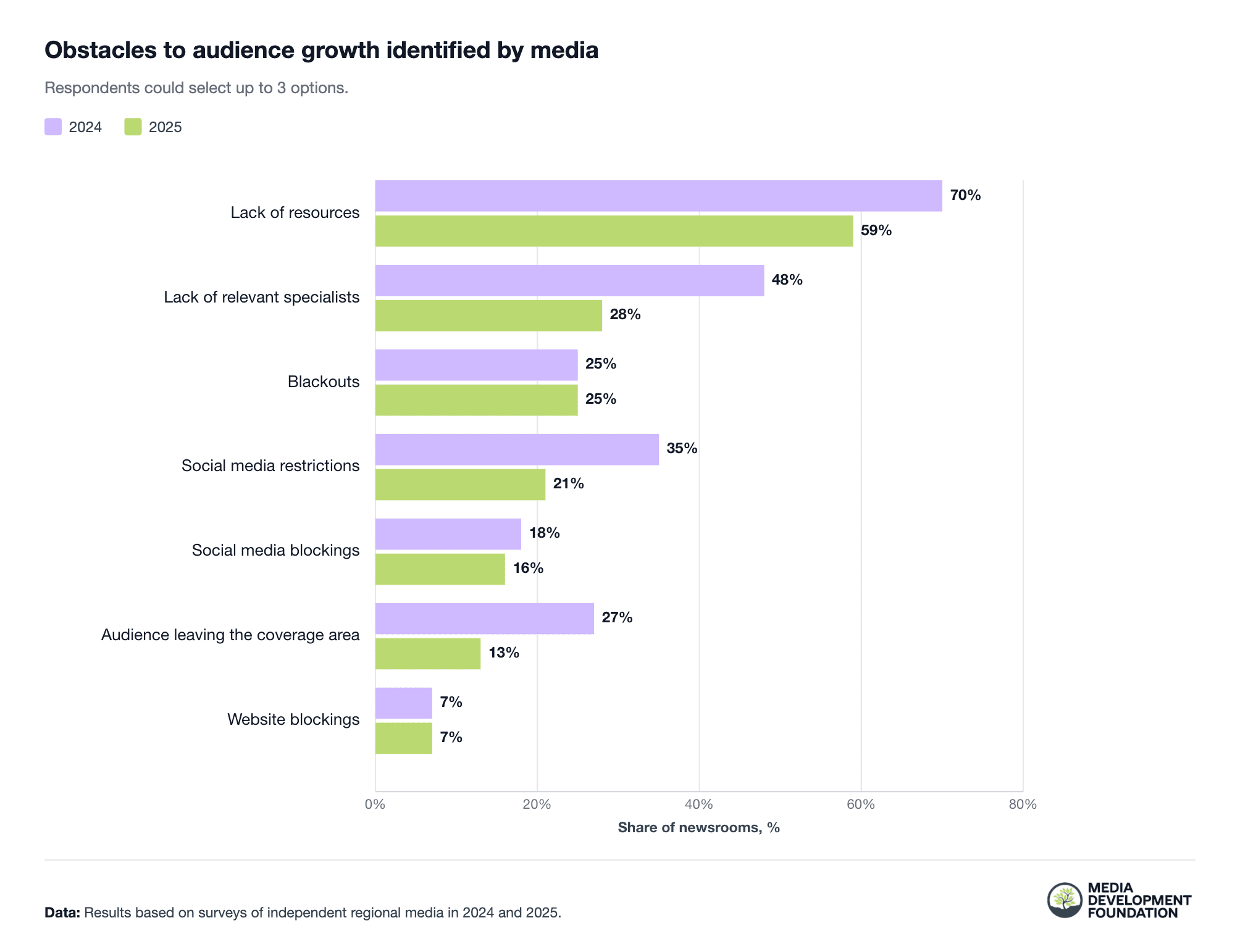
Newsrooms are seeking to innovate not only through new formats but also through new editorial priorities, particularly as a way to address audience fatigue [12] and strengthen public accountability. One notable priority for 2026 is a renewed focus on everyday local news—transportation, weather, public utilities, and other issues that have often been overshadowed by wartime coverage. Editorial teams hope that this approach will help attract broader audiences and create entry points for engagement with more complex social and civic issues.
At the same time, newsrooms are expanding their accountability and recovery coverage, with a growing emphasis on anti-corruption investigations, monitoring public procurement and tenders, and preparing for the next election cycle.
Another emerging priority is content that supports psychological resilience and community well-being. This includes positive stories about local achievements and recovery, providing an alternative to the constant flow of war-related news and coverage of military affairs. Editorial teams also plan to expand niche and lifestyle coverage, including topics such as environmental issues, urban development, European integration, food and culinary culture, and regional history.
For newsrooms covering temporarily occupied territories, explaining residents’ rights and countering propaganda through adapted content formats remains a key priority.
Text-based Formats

Text remains the foundation of content production for regional newsrooms. The most common formats in 2025 were articles and longreads (97% of newsrooms, or 59 out of 61), news (95%, 58), interviews (89%, 54), and reports (75%, 46). Analytical content was produced by 64% of newsrooms (39), while 31% (19) published columns and blogs, and 26% (16) produced reviews and digests.
Compared with 2024, the overall structure of text production remained largely unchanged. The share of newsrooms producing articles and longreads increased from 87% to 97%, while news coverage remained stable at 95% and interviews at approximately 89–92%. By contrast, the share of newsrooms producing investigative reporting and digests declined slightly.
Regional differences were minimal. Across virtually all macro-regions, the core text production model remained consistent, centered on a combination of news reporting, long-form journalism, and interviews.
Of the 61 surveyed newsrooms, 58 provided numerical data on the average number of news stories published per week, while three provided only qualitative responses. Collectively, the surveyed newsrooms produce approximately 6,000 news stories each week. The median output is 70 news stories per newsroom per week, while the average is 96.
The distribution of newsrooms by weekly news output is as follows:
Up to 9 news stories — 5% (3 newsrooms)
10–19 — 10% (6)
20–49 — 21% (12)
50–99 — 24% (14)
100 or more — 40% (23)
While news production remains intensive, the volume of in-depth text content—including articles, longreads, analytical pieces, reports, and interviews—is considerably lower. Among the 59 newsrooms that provided numerical data, the median output is five in-depth pieces per week, the average is approximately eight, and the highest reported figure is 30.
As a result, a typical newsroom produces roughly 70 news stories for every five longer-form pieces each week—a ratio of approximately 14:1.
“We’re working to ensure that in our feed, news doesn’t ‘compete’ with long-form pieces for the reader’s attention, but rather leads them further: news is a reason to visit, while analysis or interviews are a reason to stay.”
Editorial team from the Center
The share of reprinted content in the 2025 survey was measured using percentage ranges. The distribution was as follows:
All content is original (0% reprints) — 23% of newsrooms (14 out of 60);
1–20% reprints — 11% (7);
21–40% reprints — 26% (16);
41–60% reprints — 23% (14);
61–80% reprints — 15% (9).
Using the midpoint of each range as an estimate, the average share of reprinted content across the 2025 sample is approximately 31%, down from 41% in 2024 and 37% in 2023.
Several factors appear to have contributed to this decline. Respondents pointed to stricter requirements from Google and social media algorithms regarding content originality, growing audience demand for exclusive reporting, and staffing reductions that prompted some newsrooms to reduce the volume of routine news coverage—where reprints have traditionally been most common—in favor of producing more original content.
At the same time, reliance on reprinted material remains significant for a substantial share of the sector. Approximately 38% of surveyed newsrooms reported that reprints account for more than 40% of their published content.
“Overall, we calculated that over 46% of our content is completely unique, while the rest consists of reprints of press releases from news agencies, which we use to create short news items without extensive rewriting.”
Editorial team from the Center
Investigations
In 2025, 48% of surveyed newsrooms (29 out of 61) produced investigative reporting. While this figure falls short of the apparent demand for investigative journalism in Ukraine’s media landscape, it is largely consistent with the resource constraints faced by regional media organizations. At the same time, investigative reporting remains one of the sector’s highest priorities: approximately one-quarter of newsrooms identified it among the formats they are most eager to develop in the near future.
Several newsrooms reported bringing investigative journalists back onto their permanent staff in 2025. In previous years, this work was often carried out through collaborations with freelancers or specialized investigative centers.
The time required to produce an investigation varies considerably, ranging from two weeks to four or five months per story. The most commonly reported timeframe is one to two months, although respondents emphasized that they typically work on several smaller investigations simultaneously. Some newsrooms openly acknowledged that, due to limited funding and staff capacity, they were unable to produce any original investigations in 2025. They identified this as one of the most significant gaps in their editorial work.
“On average, two months per investigation, but we’re working on two or three at the same time. Without this, the volume of investigative material would simply drop to a level that’s unacceptable for us.”
Editorial team from the Center
“Due to a lack of funds and time, we did not conduct any original investigations in 2025. This is one of the areas we definitely want to bring back in 2026, if we can secure dedicated funding.”
Editorial team from the South
Regional differences are also evident. Among the newsrooms that produced investigative reporting in 2025, organizations from the Center and the East were disproportionately represented. By contrast, among those that identified investigative journalism as a priority for future development, newsrooms from the West and the South were more prominent.
This suggests that demand for investigative reporting is widespread across all regions. However, the ability to produce such work depends heavily on organizational capacity, including the presence of dedicated investigative staff and access to targeted funding and grant support.
Video Formats

By 2025, video had evolved from an optional add-on into a core component of newsroom operations. The most widespread format was short-form vertical video (Shorts and Reels), used by 89% of surveyed newsrooms (54 out of 61). This was followed by video interviews (57%, 35 newsrooms), video features and segments (56%, 34), captioned videos (56%, 34), and video reports (44%, 27). Documentaries, instructional videos, and animated content remained niche formats, produced by between 8% and 15% of newsrooms.
Compared with the previous wave of the study, the share of newsrooms systematically producing short-form vertical video increased significantly. In 2024, approximately one in two newsrooms produced this type of content, whereas by 2025 the figure had risen to nearly nine in ten. By contrast, the share of newsrooms producing longer-form video features and video reports remained relatively stable.
This points to a strategic shift toward mobile-first video formats designed primarily for consumption on smartphones. At the same time, many newsrooms are reducing investment in resource-intensive studio production unless it forms a core part of their editorial product.
“We started releasing captioned videos in a new format—with journalists on camera. This works both for team recognition and for reach.”
Editorial team from the West
“We stopped using widescreen video. We kept only vertical captions shot on a phone. Not because we don’t see value in them, but because we don’t have the resources to produce both formats to a high standard.”
Newsroom from the North
Regional differences are also evident in video production. The highest concentration of newsrooms with a diversified video portfolio (three or more video formats) is found in the Center and the East. In the South, video production tends to follow a “fewer formats, but consistent output” approach, while newsrooms in the West are more likely to experiment with video interviews and documentary projects.
Newsrooms operating near the front lines in the East and South more frequently use video reports to document conditions in local communities, evacuation efforts, and the broader impact of the war.
In most cases, video content is produced by journalists and editors themselves (38% of newsrooms, or 23 out of 61) or by dedicated in-house video specialists (30%, 18 newsrooms). Another 20% (12) rely on freelance professionals.
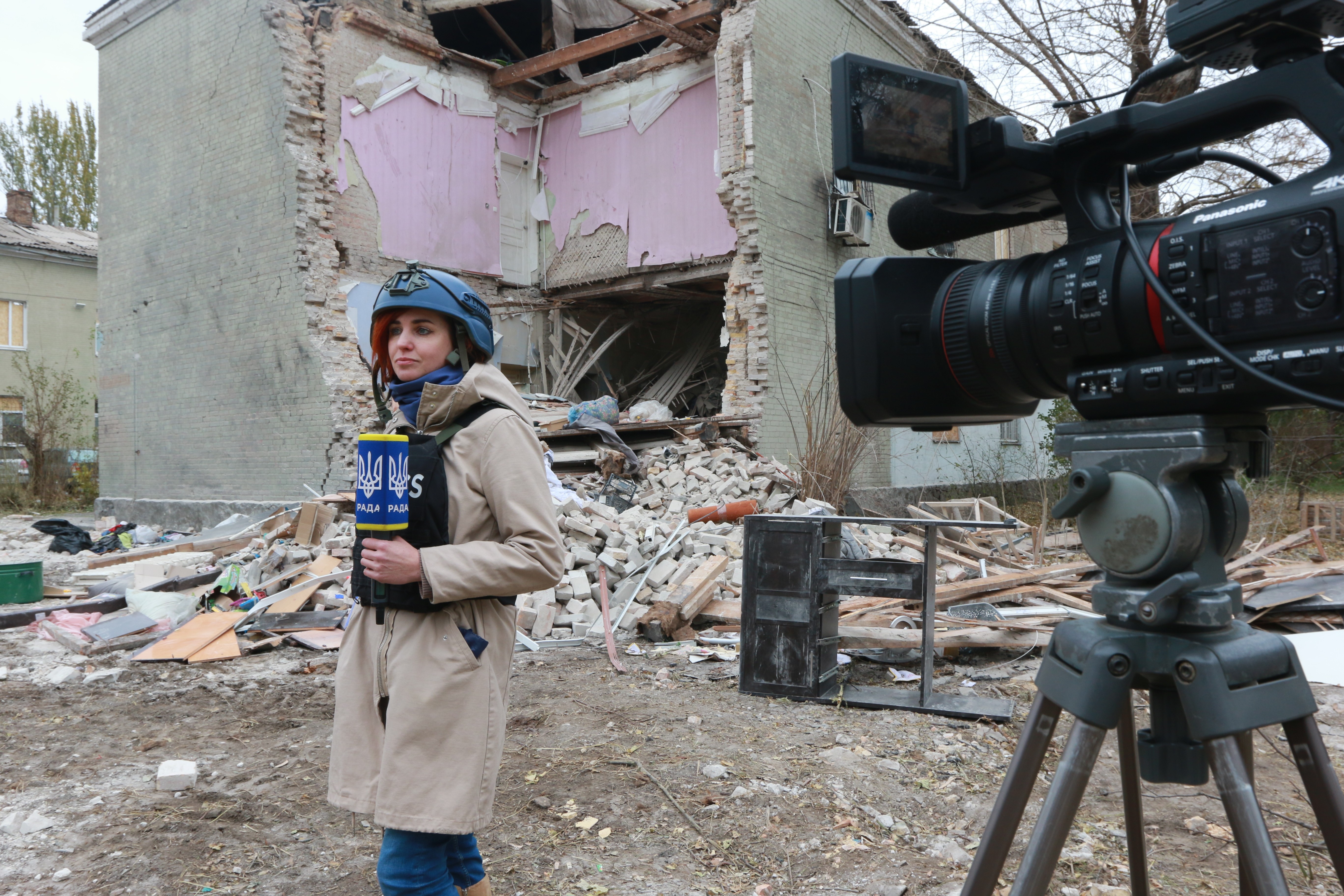
Eva Mironova – Correspondent, Zaporizhzhia, 2024 – Heavy shelling, Dmytro Khrystenko
Photo: Donbas News
Content for Social Media
A total of 93% of surveyed newsrooms (57 out of 61) create dedicated content for social media rather than simply reposting material from their websites. This represents a notable increase from 88% in 2024. Only four newsrooms (7%) continue to rely primarily on reposting or cross-posting content without adaptation, and these are predominantly small organizations with limited staff capacity.
The trend is clear: for Ukrainian regional media, social media is increasingly viewed not as a secondary distribution channel, but as a distinct editorial product with its own formats, audiences, and content strategy.
Among newsrooms that create dedicated content for social media, visual and condensed formats clearly predominate:
Stories featuring links to website articles — 82% of newsrooms;
Carousels and image series — 75%;
Short teaser posts linking to the full article on the website — 67%;
Captioned videos and short narrated videos — 31%;
Infographics — 28%;
Polls, voting features, and other interactive content — 23%;
Long-form posts that contain the full content within the social media platform itself — 18%.
Most newsrooms use three to four content repackaging formats simultaneously as part of their social media strategy.
Other Types of Content

Among other content formats used in 2025, the most common were photo reports (74%, or 45 out of 61 newsrooms), polls and audience voting features (46%, 28), infographics (44%, 27), podcasts (30%, 18), and memes (23%, 14). Compared with 2024, the use of most of these formats declined, including photo reports (from 80% to 74%), polls (from 60% to 46%), and infographics (from 50% to 44%).
Podcasts were the only format to show growth, increasing from 20% to 30% of newsrooms. At the same time, five newsrooms reported discontinuing podcast production in 2025, citing limited monetization opportunities, low organic reach, and insufficient resources to sustain the format.
“We stopped doing podcasts—there’s no funding, and they don’t get many views. If we find a relevant grant program, we’ll bring them back.”
Editorial team from the South
The broader trend in 2025 points to the repositioning of podcasts as a premium content format rather than a mass-audience product. Newsrooms that remain active in this space increasingly focus on long-form interviews and documentary series supported by project-based funding, while regular weekly podcast production is becoming less common.
Content Quality
Newsrooms’ assessments of content quality are expressed primarily in qualitative terms. Approximately half of the surveyed teams describe their content as “high-quality” or as meeting their expectations, while another quarter characterize it as generally strong but still requiring further improvement. Only a small number of newsrooms provided numerical evaluations, typically rating their content between 7 and 8 on a 10-point scale.

When asked what is needed to improve content quality, newsrooms most frequently cited access to qualified specialists (52%, or 32 out of 61), more time for in-depth reporting and content production (51%, 31), stronger skills and experience among existing staff (44%, 27), technical support and equipment (28%, 17), new ideas and creative approaches (25%, 15), and better access to experts and exclusive information (20%, 12).
Taken together, these responses suggest that human capacity remains the sector’s most significant constraint. Newsrooms are concerned not only with the number of staff available, but also with having the right mix of skills and expertise needed to produce high-quality content.
“If we hired more specialists, we could increase the amount of content and reach a whole new level of quality. We don’t have enough funds for that right now.”
Editorial team from the East
“We lack time. We could cover everything we do in greater depth—if there were two or three days between publishing a news story and a long-form piece, rather than just half a day.”
Editorial team from the Center
Regional differences in self-assessments of content quality are relatively limited. Across all macro-regions, the median rating is approximately 7 out of 10. However, regional variation becomes more apparent when examining the factors that constrain quality.
In the East and South, technical capacity—including backup power, security-related equipment, and preparedness for blackouts—is more frequently identified as a limiting factor. In the Center and West, by contrast, newsrooms are more likely to emphasize the need for access to expert sources and the expansion of editorial teams.
Artificial Intelligence in Newsrooms
By 2025, artificial intelligence had ceased to be a futuristic novelty and had become an integral part of everyday newsroom operations. Media managers’ attitudes toward AI range from active encouragement—some respondents suggested that not using AI is increasingly becoming a disadvantage—to more cautious skepticism, where the technology is viewed primarily as a supporting tool that cannot replace human judgment in complex creative and editorial work.
Most newsrooms do not yet have formally adopted policies governing the use of AI tools. In practice, however, they actively encourage their teams to use AI for routine tasks and workflow automation. Some of the more advanced organizations have even introduced dedicated roles focused on process optimization through AI and cybersecurity oversight.
Demand for AI-related training emerged as one of the most notable trends of 2025. Fourteen newsrooms (23% of the sample) identified AI integration as a priority area for professional development, while another eight (13%) listed it among the knowledge and skills currently lacking within their teams. As a result, AI has become one of the sector’s leading training priorities for 2026, alongside advertising sales and investigative journalism.
The main areas of AI application in newsrooms include:
Content processing and adaptation — transcription (the conversion of audio and video into text) has become one of the most common uses of AI, saving journalists significant amounts of time. Newsrooms also use AI to rewrite press releases and official communications in more accessible language, generate SEO-friendly headlines and descriptions, and translate news content.
Visual content creation — AI is frequently used to generate illustrations, graphics, and collages when original visual material is unavailable. Newsrooms generally label such content to indicate that it was created using AI.
Data analysis and monitoring — journalists use AI to process large volumes of information, including asset declarations, court records, and public procurement data from Prozorro. AI also supports more complex analytical work, such as calculating indicators and rankings used in transparency and accountability projects.
Organizational and operational processes — managers use AI for brainstorming, scriptwriting, advertising concepts, and customer database analysis. In some cases, AI also supports the development of automated tools and bots that collect routine information, such as updates on utility disruptions and power outages.
Among the tools most frequently mentioned by media managers are ChatGPT and Claude (for writing and idea generation), Symbli and Google Pinpoint (for transcription), Google NotebookLM (for document analysis), Fireflies (for meeting recording and note-taking), and tools such as Nano Banana and Tonu for video and audio production.
Media managers identified one of the key risks associated with AI as the growing dependence on major technology platforms and their algorithms. In particular, respondents expressed concern that AI-powered search systems may increasingly provide users with direct answers, reducing traffic to news websites and limiting audiences’ exposure to original journalistic content.
The demand for external support related to AI is also clearly reflected in the survey’s open-ended responses. Six newsrooms identified AI among their priority needs, ranging from equipment and resources for developing AI-powered products to support for conducting digital audits and integrating AI into editorial workflows. Four newsrooms specifically requested financial support for the implementation of AI tools. Two organizations included AI integration among their updated strategic priorities for 2026, framing it as a means of improving production efficiency and developing new non-news content formats.
Overall, AI was mentioned more than 30 times across the open-ended responses to the 2025 survey, appearing in contexts ranging from training needs and funding requests to strategic planning and product development.
Editorial Policy

A total of 93% of surveyed newsrooms (57 out of 61) have a written editorial policy. This represents one of the strongest formal indicators of organizational maturity within the sector and marks a noticeable increase compared with previous waves of the study. As recently as 2024, approximately 86% of newsrooms reported having formalized editorial policies or equivalent governing documents.
The remaining 7% (4 newsrooms) are primarily newly established or very small organizations that either rely on informal editorial guidelines or are in the process of formalizing their policies and internal procedures.
The most significant qualitative changes in 2025 involved updates to editorial policies governing the use of AI tools, fact-checking practices during wartime, avoiding reliance on Russian sources, and the handling of sensitive content, including coverage of frontline communities, affected civilians, and children.
Another notable trend was the incorporation of audience engagement standards into editorial policies, including guidance on communication with audiences and the moderation of hate speech and abusive behavior on social media platforms.
“In addition to our standard editorial policy, we’ve developed an internal protocol for working with AI: what we use to assist with editorial work and what we never ‘hand over’ to artificial intelligence—specifically, original quotes from interviewees and security-related information.”